LAVAGGIO DOPO LA POSA
Il lavaggio dopo la posa è una fase di fondamentale importanza per tutti gli interventi successivi
e per la manutenzione.
La pulizia di fine cantiere fatta con prodotti a base acida tamponati, quali ad esempio Deterdek
di Fila o Cement Remover di Faber etc. va eseguita una sola volta e presenta l’ulteriore vantag-
gio di conferire uniformità cromatica alla superficie.
Con il lavaggio acido dopo la posa si eliminano i residui di posa e il normale sporco di can-
tiere come: malta, colla, pittura, sporco da cantiere di varia natura. E’ bene sapere che oltre il
90% delle contestazioni in cantiere è dovuto ad un cattivo, o addirittura inesistente, lavaggio
con detergente acido dopo posa. Per evitare che un prodotto a base acida usato per la prima
pulizia vada ad intaccare il riempimento a base cementizia delle fughe, è necessario, prima
dell’operazione di pulizia, bagnare il pavimento af
finché le fughe vengano impregnate e per-
tanto protette dall’azione corrosiva dell’acido stesso.
È opportuno:
• Togliere con appositi detergenti a base alcalina sostanze grasse o simili
• Procedere al lavaggio dopo la posa
• Risciacquare abbondantemente il pavimento, raccogliendo l’acqua residua.
• La pulizia si esegue dopo 4-5 giorni dalla stuccatura (lo stucco deve indurire) e non oltre i 10
giorni, oltre questi tempi la pulizia può diventare molto più laboriosa; attenersi scrupolosamente
ai consigli riportati dal produttore di detergenti.
Fare sempre test preventivi (su una piastrella non posata), in particolare per prodotti lappati o
levigati.
PULIZIA E MANUTENZIONE
MANUTENZIONE ORDINARIA
Si consiglia l’utilizzo di un comune detergente neutro diluito in acqua calda. Evitare l’utilizzo di
prodotti acidi, alcalini, ceranti e/o impregnanti.
Nella pulizia ordinaria occorre limitare al massimo l’uso di mezzi abrasivi (ad esempio: paglietta di
metallo, spugnette di ferro o acciaio). Questa precauzione diventa un obbligo nel caso di piastrelle
con superficie lucida, più esposte ad effetti visibili di scalfitture, graffi...
In caso di sporchi più intensi o di superfici particolarmente strutturate, usare un detergente a base
alcalina risciacquando al termine del lavaggio.
Nella pratica quotidiana occorre considerare che certi tipi di sporco (polvere, sabbia) aumentano
l’effetto abrasivo del traffico pedonale. Cercare quindi di prevenire la presenza di questa tipologia
di sporco dall’esterno, predisponendo l’utilizzo di zerbino o stuoino all’ingresso.
RIMOZIONE DI PATINE LUCIDE
Nei normali detergenti in commercio sono a volte contenute cere o additivi lucidanti che, lavaggio
dopo lavaggio, depositano sul pavimento patine lucide, causa di noiose alonature. Patine di questo
tipo possono essere depositate anche da alcuni stucchi per le fughe. Semplici alimenti come Coca
Cola, vino, acqua, etc., cadendo sul pavimento tolgono questa patina lucida e ripristinano l’aspetto
originale più opaco delle piastrelle. In mezzo al pavimento più lucido, le zone senza cera appaiono
come aloni opachi, in realtà sono le uniche parti pulite del pavimento.
In questi casi, dopo aver fatto un test preventivo, bisogna:
• Togliere la patina lucida da tutto il pavimento con un tipo di detergente a base acida.
• Utilizzare per le pulizie quotidiane, detergenti neutri che non contengono né cere né patine
lucidanti.
MANUTENZIONE STRAORDINARIA
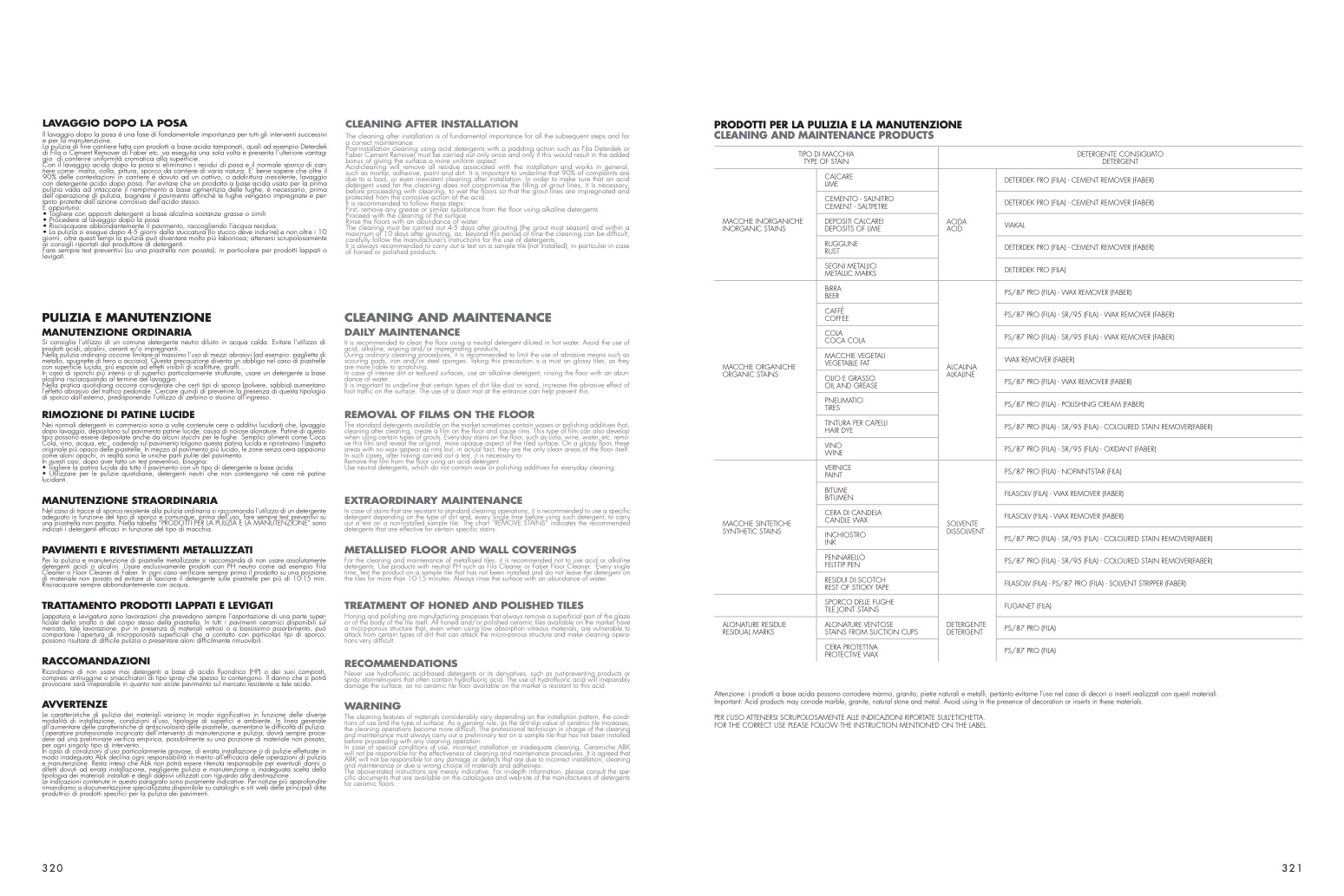
Nel caso di tracce di sporco resistente alla pulizia ordinaria si raccomanda l’utilizzo di un detergente
adeguato in funzione del tipo di sporco e comunque, prima dell’uso, fare sempre test preventivi su
una piastrella non posata. Nella tabella “PRODOTTI PER LA PULIZIA E LA MANUTENZIONE” sono
indicati i detergenti efficaci in funzione del tipo di macchia.
PAVIMENTI E RIVESTIMENTI METALLIZZATI
Per la pulizia e manutenzione di piastrelle metallizzate si raccomanda di non usare assolutamente
detergenti acidi o alcalini. Usare esclusivamente prodotti con PH neutro come ad esempio Fila
Cleaner o Floor Cleaner di Faber. In ogni caso verificare sempre prima il prodotto su una porzione
di materiale non posato ed evitare di lasciare il detergente sulle piastrelle per più di 10-15 min.
Risciacquare sempre abbondantemente con acqua.
TRATTAMENTO PRODOTTI LAPPATI E LEVIGATI
Lappatura e Levigatura sono lavorazioni che prevedono sempre l’asportazione di una parte super-
ficiale dello smalto o del corpo stesso della piastrella. In tutti i pavimenti ceramici disponibili sul
mercato, tale lavorazione, pur in presenza di materiali vetrosi o a bassissimo assorbimento, può
comportare l’apertura di microporosità superficiali che a contatto con particolari tipi di sporco,
possono risultare di difficile pulizia o presentare aloni difficilmente rimuovibili.
RACCOMANDAZIONI
Ricordiamo di non usare mai detergenti a base di acido fluoridrico (HP) o dei suoi composti,
compresi antiruggine o smacchiatori di tipo spray che spesso lo contengono. Il danno che si potrà
provocare sarà irreparabile in quanto non esiste pavimento sul mercato resistente a tale acido.
AVVERTENZE
Le caratteristiche di pulizia dei materiali variano in modo significativo in funzione delle diverse
modalità di installazione, condizioni d’uso, tipologie di superfici e ambiente. In linea generale
all’aumentare delle caratteristiche di antiscivolosità delle piastrelle, aumentano le difficoltà di pulizia.
L’operatore professionale incaricato dell’intervento di manutenzione e pulizia, dovrà sempre proce-
dere ad una preliminare verifica empirica, possibilmente su una porzione di materiale non posato,
per ogni singolo tipo di intervento.
In caso di condizioni d’uso particolarmente gravose, di errata installazione o di pulizie effettuate in
modo inadeguato Abk declina ogni responsabilità in merito all’efficacia delle operazioni di pulizia
e manutenzione. Resta inteso che Abk non potrà essere ritenuta responsabile per eventuali danni o
difetti dovuti ad errata installazione, negligente pulizia e manutenzione o inadeguata scelta della
tipologia dei materiali installati e degli adesivi utilizzati con riguardo alla destinazione.
Le indicazioni contenute in questo paragrafo sono puramente indicative. Per notizie più approfondite
rimandiamo a documentazione specializzata disponibile su cataloghi e siti web delle principali ditte
produttrici di prodotti specifici per la pulizia dei pavimenti.
CLEANING AFTER INSTALLATION
The cleaning after installation is of fundamental importance for all the subsequent steps and for
a correct maintenance.
Post-installation cleaning using acid detergents with a padding action such as Fila Deterdek or
Faber Cement Remover must be carried out only once and only if this would result in the added
bonus of giving the surface a more uniform aspect.
Acid-cleaning will remove all residue associated with the installation and works in general,
such as mortar, adhesive, paint and dirt. It is important to underline that 90% of complaints are
due to a bad, or even inexistent cleaning after installation. In order to make sure that an acid
detergent used for the cleaning does not compromise the filling of grout lines, it is necessary,
before proceeding with cleaning, to wet the floors so that the grout lines are impregnated and
protected from the corrosive action of the acid.
It is recommended to follow these steps:
First, remove any grease or similar substance from the floor using alkaline detergents
Proceed with the cleaning of the surface
Rinse the floors with an abundance of water
The cleaning must be carried out 4-5 days after grouting (the grout must season) and within a
maximum of 10 days after grouting, as, beyond this period of time the cleaning can be difficult,
carefully follow the manufacturer’s instructions for the use of detergents.
It is always recommended to carry out a test on a sample tile (not installed), in particular in case
of honed or polished products.
CLEANING AND MAINTENANCE
DAILY MAINTENANCE
It is recommended to clean the floor using a neutral detergent diluted in hot water. Avoid the use of
acid, alkaline, waxing and/or impregnating products.
During ordinary cleaning procedures, it is recommended to limit the use of abrasive means such as
scouring pads, iron and/or steel sponges. Taking this precaution is a must on glossy tiles, as they
are more liable to scratching.
In case of intense dirt or textured surfaces, use an alkaline detergent, rinsing the floor with an abun-
dance of water.
It is important to underline that certain types of dirt like dust or sand, increase the abrasive effect of
foot traffic on the surface. The use of a door mat at the entrance can help prevent this.
REMOVAL OF FILMS ON THE FLOOR
The standard detergents available on the market sometimes contain waxes or polishing additives that,
cleaning after cleaning, create a film on the floor and cause rims. This type of film can also develop
when using certain types of grouts. Every-day stains on the floor, such as cola, wine, water, etc. remo-
ve this film and reveal the original, more opaque aspect of the tiled surface. On a glossy floor, these
areas with no wax appear as rims but, in actual fact, they are the only clean areas of the floor itself.
In such cases, after having carried out a test, it is necessary to:
Remove the film from the floor using an acid detergent.
Use neutral detergents, which do not contain wax or polishing additives for everyday cleaning.
EXTRAORDINARY MAINTENANCE
In case of stains that are resistant to standard cleaning operations, it is recommended to use a specific
detergent depending on the type of dirt and, every single time before using such detergent, to carry
out a test on a non-installed sample tile. The chart “REMOVE STAINS” indicates the recommended
detergents that are effective for certain specific stains.
METALLISED FLOOR AND WALL COVERINGS
For the cleaning and maintenance of metallised tiles, it is recommended not to use acid or alkaline
detergents. Use products with neutral PH such as Fila Cleaner or Faber Floor Cleaner. Every single
time, test the product on a sample tile that has not been installed and do not leave the detergent on
the tiles for more than 10-15 minutes. Always rinse the surface with an abundance of water.
TREATMENT OF HONED AND POLISHED TILES
Honing and polishing are manufacturing processes that always remove a superficial part of the glaze
or of the body of the tile itself. All honed and/or polished ceramic tiles available on the market have
a micro-porous structure that, even when using low absorption vitreous materials, are vulnerable to
attack from certain types of dirt that can attack the micro-porous structure and make cleaning opera-
tions very difficult.
RECOMMENDATIONS
Never use hydrofluoric acid-based detergents or its derivatives, such as rust-preventing products or
spray stain-removers that often contain hydrofluoric acid. The use of hydrofluoric acid will irreparably
damage the surface, as no ceramic tile floor available on the market is resistant to this acid.
WARNING
The cleaning features of materials considerably vary depending on the installation pattern, the condi-
tions of use and the type of surface. As a general rule, as the anti-slip value of ceramic tile increases,
the cleaning operations become more difficult. The professional technician in charge of the cleaning
and maintenance must always carry out a preliminary test on a sample tile that has not been installed
before proceeding with any cleaning operation.
In case of special conditions of use, incorrect installation or inadequate cleaning, Ceramiche ABK
will not be responsible for the effectiveness of cleaning and maintenance procedures. It is agreed that
ABK will not be responsible for any damage or defects that are due to incorrect installation, cleaning
and maintenance or due a wrong choice of materials and adhesives.
The above-stated instructions are merely indicative. For in-depth information, please consult the spe-
cific documents that are available on the catalogues and web-site of the manufacturers of detergents
for ceramic floors.
PRODOTTI PER LA PULIZIA E LA MANUTENZIONE
CLEANING AND MAINTENANCE PRODUCTS
TIPO DI MACCHIA
TYPE OF STAIN
DETERGENTE CONSIGLIATO
DETERGENT
DETERDEK PRO (FILA) - CEMENT REMOVER (FABER)
DETERDEK PRO (FILA) - CEMENT REMOVER (FABER)
VIAKAL
DETERDEK PRO (FILA) - CEMENT REMOVER (FABER)
DETERDEK PRO (FILA)
PS/87 PRO (FILA) - WAX REMOVER (FABER)
PS/87 PRO (FILA) - SR/95 (FILA) - WAX REMOVER (FABER)
PS/87 PRO (FILA) - SR/95 (FILA) - WAX REMOVER (FABER)
WAX REMOVER (FABER)
PS/87 PRO (FILA) - WAX REMOVER (FABER)
PS/87 PRO (FILA) - POLISHING CREAM (FABER)
PS/87 PRO (FILA) - SR/95 (FILA) - COLOURED STAIN REMOVER(FABER)
PS/87 PRO (FILA) - SR/95 (FILA) - OXIDANT (FABER)
PS/87 PRO (FILA) - NOPAINTSTAR (FILA)
FILASOLV (FILA) - WAX REMOVER (FABER)
FILASOLV (FILA) - WAX REMOVER (FABER)
PS/87 PRO (FILA) - SR/95 (FILA) - COLOURED STAIN REMOVER(FABER)
PS/87 PRO (FILA) - SR/95 (FILA) - COLOURED STAIN REMOVER(FABER)
FILASOLV (FILA) - PS/87 PRO (FILA) - SOLVENT STRIPPER (FABER)
FUGANET (FILA)
PS/87 PRO (FILA)
PS/87 PRO (FILA)
CALCARE
LIME
CEMENTO - SALNITRO
CEMENT - SALTPETRE
DEPOSITI CALCAREI
DEPOSITS OF LIME
MACCHIE VEGETALI
VEGETABLE FAT
ACIDA
ACID
RUGGUNE
RUST
SEGNI METALLICI
METALLIC MARKS
BIRRA
BEER
CAFFÈ
COFFEE
COLA
COCA COLA
ALCALINA
ALKALINE
OLIO E GRASSO
OIL AND GREASE
PNEUMATICI
TIRES
TINTURA PER CAPELLI
HAIR DYE
VINO
WINE
VERNICE
PAINT
BITUME
BITUMEN
CERA DI CANDELA
CANDLE WAX
SOLVENTE
DISSOLVENT
INCHIOSTRO
INK
PENNARELLO
FELT-TIP PEN
RESIDUI DI SCOTCH
REST OF STICKY TAPE
SPORCO DELLE FUGHE
TILE JOINT STAINS
ALONATURE VENTOSE
STAINS FROM SUCTION CUPS
MACCHIE INORGANICHE
INORGANIC STAINS
MACCHIE ORGANICHE
ORGANIC STAINS
MACCHIE SINTETICHE
SYNTHETIC STAINS
ALONATURE RESIDUE
RESIDUAL MARKS
DETERGENTE
DETERGENT
320
321
CERA PROTETTIVA
PROTECTIVE WAX
Attenzione: i prodotti a base acida possono corrodere marmo, granito, pietre naturali e metalli, pertanto evitarne l’uso nel caso di decori o inserti realizzati con questi materiali.
Important: Acid products may corrode marble, granite, natural stone and metal. Avoid using in the presence of decoration or inserts in these materials.
PER L’USO ATTENERSI SCRUPOLOSAMENTE ALLE INDICAZIONI RIPORTATE SULL’ETICHETTA.
FOR THE CORRECT USE PLEASE FOLLOW THE INSTRUCTION MENTIONED ON THE LABEL.

