14
Valdama
+
Maniluvio
design by Marta Sanson
i
"Laverò" è l’origine liturgica del
lavamani; "Laverò le mie mani fra
gli innocenti" è il sesto versett
o
del Salmo 25.
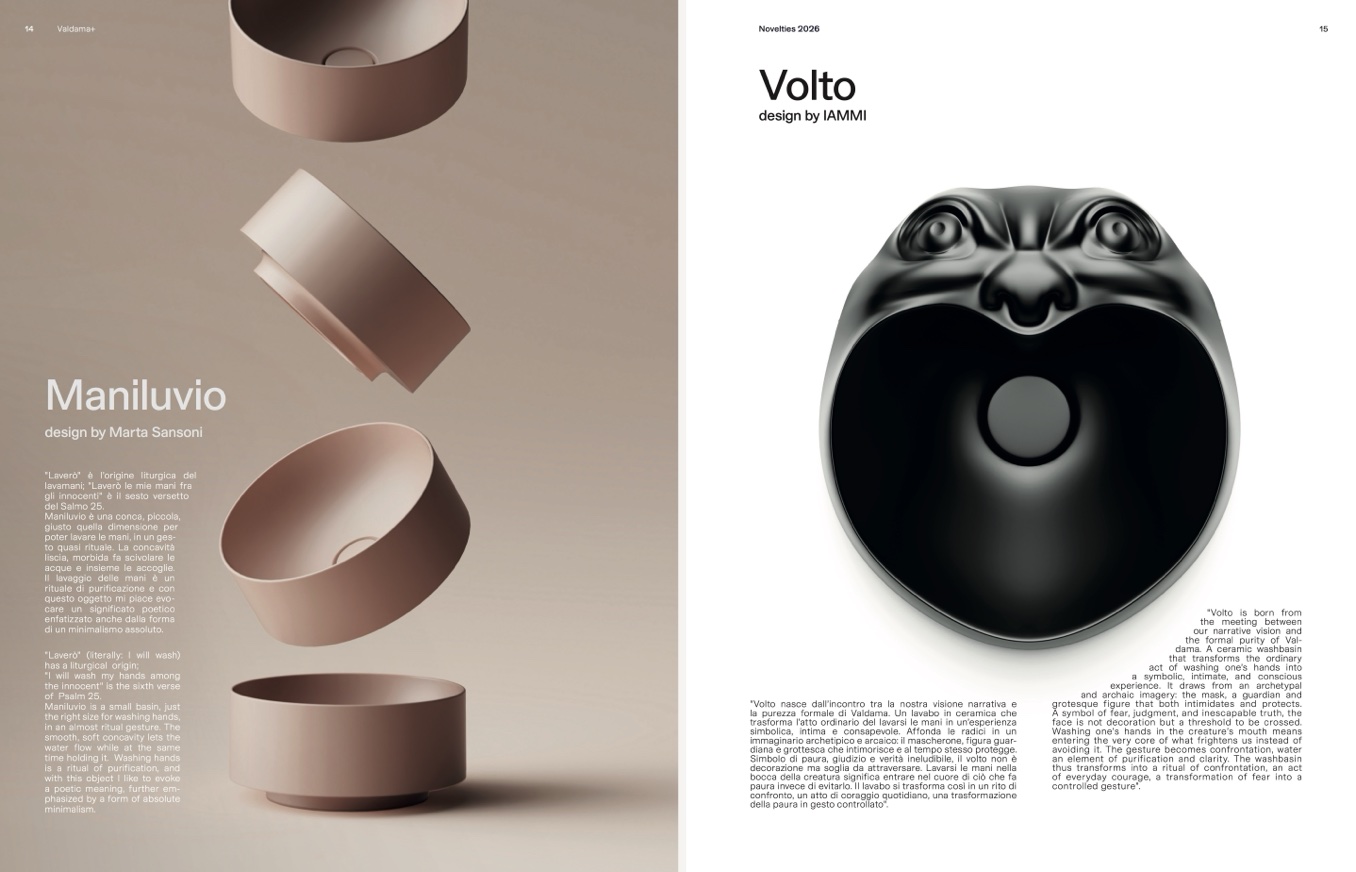
Maniluvio è una conca, piccola
,
giusto quella dimensione per
poter lavare le mani, in un ges
-
to quasi rituale. La concavità
liscia, morbida fa scivolare le
acque e insieme le accoglie.
Il lavaggio delle mani è un
rituale di purificazione e co
n
questo oggetto mi piace evo-
care un significato poetico
enfatizzato anche dalla forma
di un minimalismo assoluto
.
"Laverò" (literally: I will wash)
has a liturgical origin;
"I will wash my hands amon
g
the innocent" is the sixth verse
of Psalm 25.
Maniluvio is a small basin, jus
t
the right size for washing hands
,
in an almost ritual gesture. The
smooth, soft concavity lets the
water flow while at the sam
e
time holding it. Washing hand
s
is a ritual of purification, an
d
with this object I like to evok
e
a poetic meaning, further em-
phasized by a form of absolute
minimalism.
Novelties 202
6
Novelties 2026
1
5
Volt
o
design by IAMM
I
"Volto nasce dall’incontro tra la nostra visione narrativa
e
la purezza formale di Valdama. Un lavabo in ceramica ch
e
trasforma l’atto ordinario del lavarsi le mani in un’esperienz
a
simbolica, intima e consapevole. Affonda le radici in u
n
immaginario archetipico e arcaico: il mascherone, figura guar
-
diana e grottesca che intimorisce e al tempo stesso protegge
.
Simbolo di paura, giudizio e verità ineludibile, il volto non
è
decorazione ma soglia da attraversare. Lavarsi le mani nell
a
bocca della creatura significa entrare nel cuore di ciò che f
a
paura invece di evitarlo. Il lavabo si trasforma così in un rito d
i
confronto, un atto di coraggio quotidiano, una trasformazion
e
della paura in gesto controllato"
.
"Volto is born from
the meeting betwee
n
our narrative vision an
d
the formal purity of Val
-
dama. A ceramic washbasi
n
that transforms the ordinary
act of washing one’s hands into
a symbolic, intimate, and conscious
experience. It draws from an archetypal
and archaic imagery: the mask, a guardian and
grotesque figure that both intimidates and protects.
A symbol of fear, judgment, and inescapable truth, th
e
face is not decoration but a threshold to be crossed.
Washing one’s hands in the creature’s mouth means
entering the very core of what frightens us instead of
avoiding it. The gesture becomes confrontation, water
an element of purification and clarity. The washbasin
thus transforms into a ritual of confrontation, an ac
t
of everyday courage, a transformation of fear into a
controlled gesture”.

