Folded
collection
design
production
material
features
thickness
nominal sizes
specification
patents
category
XL
Laying and maintenance tips
Folded XL
Raw Edges, 2017
Industrial
Unglazed homogeneous porcelain stoneware
Squared and rectified slabs each one exactly the same as the others
5,6 mm
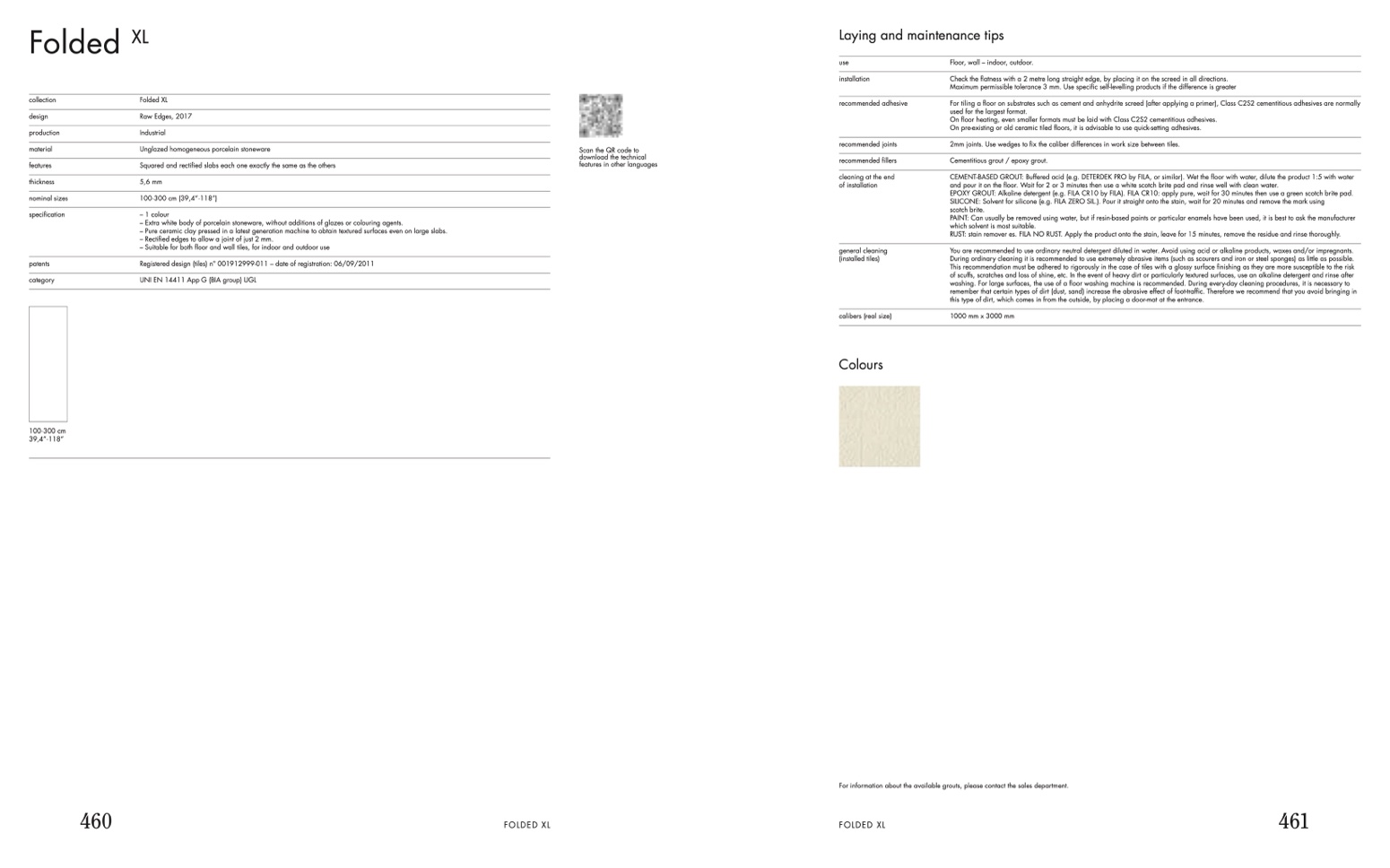
100·300 cm (39,4”·118”)
– 1 colour
– Extra white body of porcelain stoneware, without additions of glazes or colouring agents.
– Pure ceramic clay pressed in a latest generation machine to obtain textured surfaces even on large slabs.
– Rectified edges to allow a joint of just 2 mm.
– Suitable for both floor and wall tiles, for indoor and outdoor use
Registered design (tiles) n° 001912999-011 – date of registration: 06/09/2011
UNI EN 14411 App G (BIA group) UGL
Scan the QR code to
download the technical
features in other languages
use
installation
recommended adhesive
recommended joints
recommended fillers
cleaning at the end
of installation
general cleaning
(installed tiles)
calibers (real size)
Colours
Floor, wall – indoor, outdoor.
Check the flatness with a 2 metre long straight edge, by placing it on the screed in all directions.
Maximum permissible tolerance 3 mm. Use specific self-levelling products if the difference is greater
For tiling a floor on substrates such as cement and anhydrite screed (after applying a primer), Class C2S2 cementitious adhesives are normally
used for the largest format.
On floor heating, even smaller formats must be laid with Class C2S2 cementitious adhesives.
On pre-existing or old ceramic tiled floors, it is advisable to use quick-setting adhesives.
2mm joints. Use wedges to fix the caliber differences in work size between tiles.
Cementitious grout / epoxy grout.
CEMENT-BASED GROUT: Buffered acid (e.g. DETERDEK PRO by FILA, or similar). Wet the floor with water, dilute the product 1:5 with water
and pour it on the floor. Wait for 2 or 3 minutes then use a white scotch brite pad and rinse well with clean water.
EPOXY GROUT: Alkaline detergent (e.g. FILA CR10 by FILA). FILA CR10: apply pure, wait for 30 minutes then use a green scotch brite pad.
SILICONE: Solvent for silicone (e.g. FILA ZERO SIL.). Pour it straight onto the stain, wait for 20 minutes and remove the mark using
scotch brite.
PAINT: Can usually be removed using water, but if resin-based paints or particular enamels have been used, it is best to ask the manufacturer
which solvent is most suitable.
RUST: stain remover es. FILA NO RUST. Apply the product onto the stain, leave for 15 minutes, remove the residue and rinse thoroughly.
You are recommended to use ordinary neutral detergent diluted in water. Avoid using acid or alkaline products, waxes and/or impregnants.
During ordinary cleaning it is recommended to use extremely abrasive items (such as scourers and iron or steel sponges) as little as possible.
This recommendation must be adhered to rigorously in the case of tiles with a glossy surface finishing as they are more susceptible to the risk
of scuffs, scratches and loss of shine, etc. In the event of heavy dirt or particularly textured surfaces, use an alkaline detergent and rinse after
washing. For large surfaces, the use of a floor washing machine is recommended. During every-day cleaning procedures, it is necessary to
remember that certain types of dirt (dust, sand) increase the abrasive effect of foot-traffic. Therefore we recommend that you avoid bringing in
this type of dirt, which comes in from the outside, by placing a door-mat at the entrance.
1000 mm x 3000 mm
100·300 cm
39,4”·118”
460
FOLDED XL
For information about the available grouts, please contact the sales department.
FOLDED XL
461

