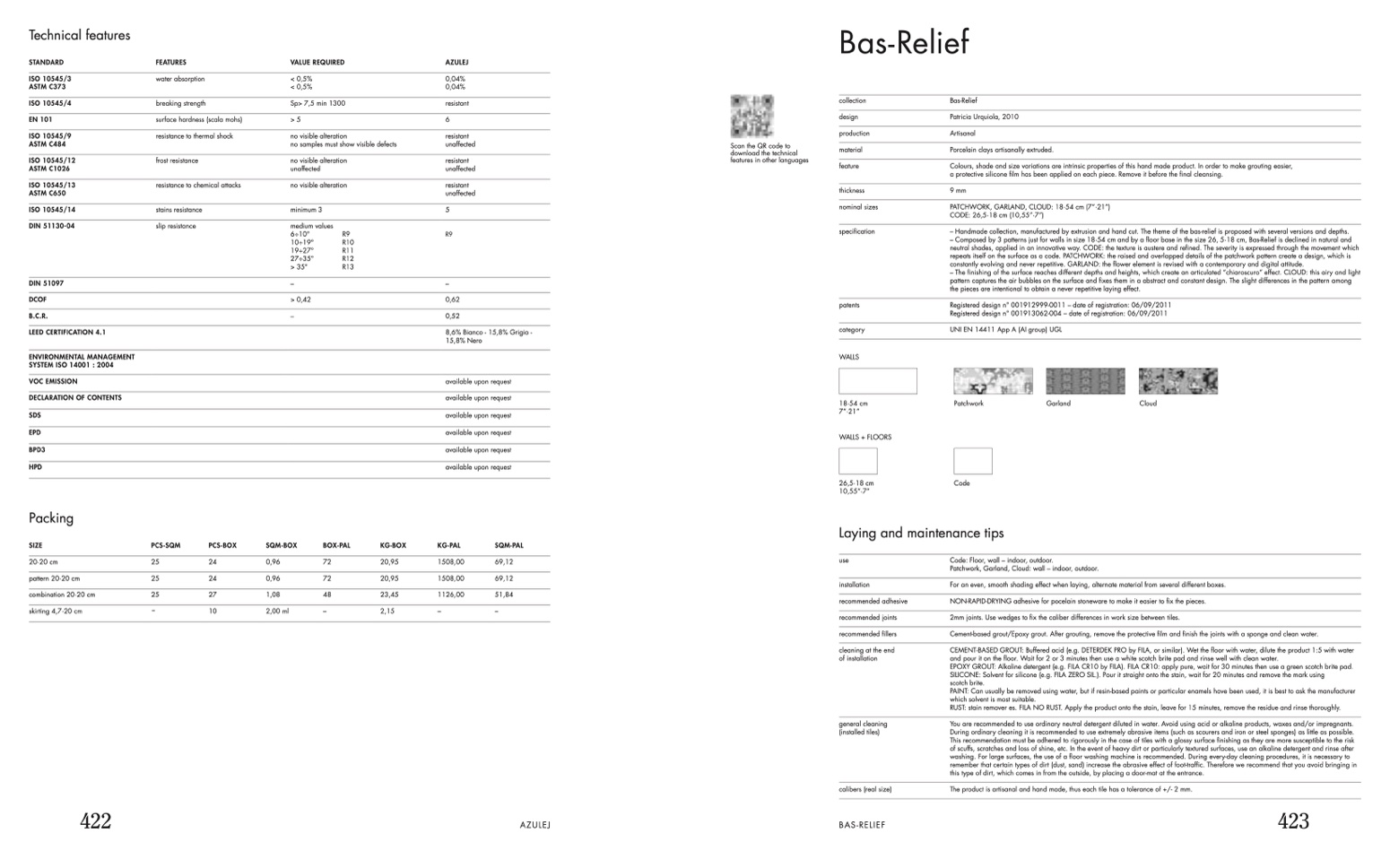
Technical features
STANDARD
ISO 10545/3
ASTM C373
ISO 10545/4
EN 101
ISO 10545/9
ASTM C484
ISO 10545/12
ASTM C1026
ISO 10545/13
ASTM C650
ISO 10545/14
DIN 51130-04
DIN 51097
DCOF
B.C.R.
LEED CERTIFICATION 4.1
ENVIRONMENTAL MANAGEMENT
SYSTEM ISO 14001 : 2004
VOC EMISSION
DECLARATION OF CONTENTS
SDS
EPD
BPD3
HPD
Packing
SIZE
20·20 cm
pattern 20·20 cm
combination 20·20 cm
skirting 4,7·20 cm
FEATURES
water absorption
breaking strength
surface hardness (scala mohs)
resistance to thermal shock
frost resistance
resistance to chemical attacks
VALUE REQUIRED
< 0,5%
< 0,5%
Sp> 7,5 min 1300
>5
no visible alteration
no samples must show
no visible alteration
unaffected
no visible alteration
AZULEJ
0,04%
0,04%
resistant
6
resistant
unaffected
resistant
unaffected
resistant
unaffected
5
R9
–
0,62
0,52
8,6% Bianco - 15,8% Grigio -
15,8% Nero
available upon request
available upon request
available upon request
available upon request
available upon request
available upon request
Bas-Relief
visible defects
Scan the QR code to
download the technical
features in other languages
collection
design
production
material
feature
thickness
nominal sizes
specification
patents
category
WALLS
18·54 cm
7”·21”
WALLS + FLOORS
26,5·18 cm
10,55”·7”
Bas-Relief
Patricia Urquiola, 2010
Artisanal
Porcelain clays artisanally extruded.
Colours, shade and size variations are intrinsic properties of this hand made product. In order to make grouting easier,
a protective silicone film has been applied on each piece. Remove it before the final cleansing.
9 mm
PATCHWORK, GARLAND, CLOUD: 18·54 cm (7”·21”)
CODE: 26,5·18 cm (10,55”·7”)
– Handmade collection, manufactured by extrusion and hand cut. The theme of the bas-relief is proposed with several versions and depths.
– Composed by 3 patterns just for walls in size 18·54 cm and by a floor base in the size 26, 5·18 cm, Bas-Relief is declined in natural and
neutral shades, applied in an innovative way. CODE: the texture is austere and refined. The severity is expressed through the movement which
repeats itself on the surface as a code. PATCHWORK: the raised and overlapped details of the patchwork pattern create a design, which is
constantly evolving and never repetitive. GARLAND: the flower element is revised with a contemporary and digital attitude.
– The finishing of the surface reaches different depths and heights, which create an articulated “chiaroscuro” effect. CLOUD: this airy and light
pattern captures the air bubbles on the surface and fixes them in a abstract and constant design. The slight differences in the pattern among
the pieces are intentional to obtain a never repetitive laying effect.
Registered design n° 001912999-0011 – date of registration: 06/09/2011
Registered design n° 001913062-004 – date of registration: 06/09/2011
stains resistance
slip resistance
minimum 3
medium values
6÷10°
10÷19°
19÷27°
27÷35°
> 35°
–
> 0,42
–
R9
R10
R11
R12
R13
UNI EN 14411 App A (AI group) UGL
Patchwork
Code
Garland
Cloud
PCS·SQM
25
25
25
-
PCS·BOX
24
24
27
10
SQM·BOX
0,96
0,96
1,08
2,00 ml
BOX·PAL
72
72
48
–
KG·BOX
20,95
20,95
23,45
2,15
KG·PAL
1508,00
1508,00
1126,00
–
SQM·PAL
69,12
69,12
51,84
–
Laying and maintenance tips
use
installation
recommended adhesive
recommended joints
recommended fillers
cleaning at the end
of installation
general cleaning
(installed tiles)
calibers (real size)
Code: Floor, wall – indoor, outdoor.
Patchwork, Garland, Cloud: wall – indoor, outdoor.
For an even, smooth shading effect when laying, alternate material from several different boxes.
NON-RAPID-DRYING adhesive for pocelain stoneware to make it easier to fix the pieces.
2mm joints. Use wedges to fix the caliber differences in work size between tiles.
Cement-based grout/Epoxy grout. After grouting, remove the protective film and finish the joints with a sponge and clean water.
CEMENT-BASED GROUT: Buffered acid (e.g. DETERDEK PRO by FILA, or similar). Wet the floor with water, dilute the product 1:5 with water
and pour it on the floor. Wait for 2 or 3 minutes then use a white scotch brite pad and rinse well with clean water.
EPOXY GROUT: Alkaline detergent (e.g. FILA CR10 by FILA). FILA CR10: apply pure, wait for 30 minutes then use a green scotch brite pad.
SILICONE: Solvent for silicone (e.g. FILA ZERO SIL.). Pour it straight onto the stain, wait for 20 minutes and remove the mark using
scotch brite.
PAINT: Can usually be removed using water, but if resin-based paints or particular enamels have been used, it is best to ask the manufacturer
which solvent is most suitable.
RUST: stain remover es. FILA NO RUST. Apply the product onto the stain, leave for 15 minutes, remove the residue and rinse thoroughly.
You are recommended to use ordinary neutral detergent diluted in water. Avoid using acid or alkaline products, waxes and/or impregnants.
During ordinary cleaning it is recommended to use extremely abrasive items (such as scourers and iron or steel sponges) as little as possible.
This recommendation must be adhered to rigorously in the case of tiles with a glossy surface finishing as they are more susceptible to the risk
of scuffs, scratches and loss of shine, etc. In the event of heavy dirt or particularly textured surfaces, use an alkaline detergent and rinse after
washing. For large surfaces, the use of a floor washing machine is recommended. During every-day cleaning procedures, it is necessary to
remember that certain types of dirt (dust, sand) increase the abrasive effect of foot-traffic. Therefore we recommend that you avoid bringing in
this type of dirt, which comes in from the outside, by placing a door-mat at the entrance.
The product is artisanal and hand made, thus each tile has a tolerance of +/- 2 mm.
422
AZULEJ
BAS-RELIEF
423

