Project plannin
g
FSR
4.321
FLEXWELL® Safety Pipe
Basic planning parameters
Routing
Routing with branching off pipes
Where a number of differently located users need to be sup-
plied by piping, this is normally done with conventional pipin
g
by laying feeder lines branching o
ff from the main line. This
makes it necessary to install T-branches, creating extra wor
k
on site. In the case of underground piping this also creates an
extra risk, since the branches can neither be seen nor easil
y
checked for leaks.
The flexibility of FLEXWELL® Safety Pipe allows it to be laid ac
-
cording to the “looping in” method familiar from high-voltag
e
power cables (see the diagramme)
.
A
User
FLEXWELL
®
Safety Pip
e
looped in
,
no branches
undergroun
d
“Looping in” means
:
1. The actual branching-o
ff pipe, illustrated as a bridgeover,
lies in an area where it is protected or easy to check (e.g. i
n
a manhole pit or the boiler room.)
2. There is no connection to be installed by hand in th
e
ground. This means that the corrosion-proo
fing fitted during
manufacture in our factory is at no point interrupted in th
e
underground routing
.
Corrosion-proofed and completely monitorable T-branches
can be delivered for special cases. We would like to point ou
t
however that “looping in” is normally much more economical
than fitting monitorable T-branches
.
Main supply line wit
h
B
C
branching feede
r
lines and T-branche
s
as used i
n
conventional pipin
g
The looping in method
Pipe gradient, existing supply lines, stray current
s
It makes a lot of sense to lay FLEXWELL® Safety Pipe wit
h
the gradients normally used in piping construction in order to
be able to easily evacuate and vent the pipes or systems. I
n
heavily built-up areas it is often the case, however, that alread
y
existing supply lines cross the planned routing. As long as no
minimum distances between lines are stipulated by law or b
y
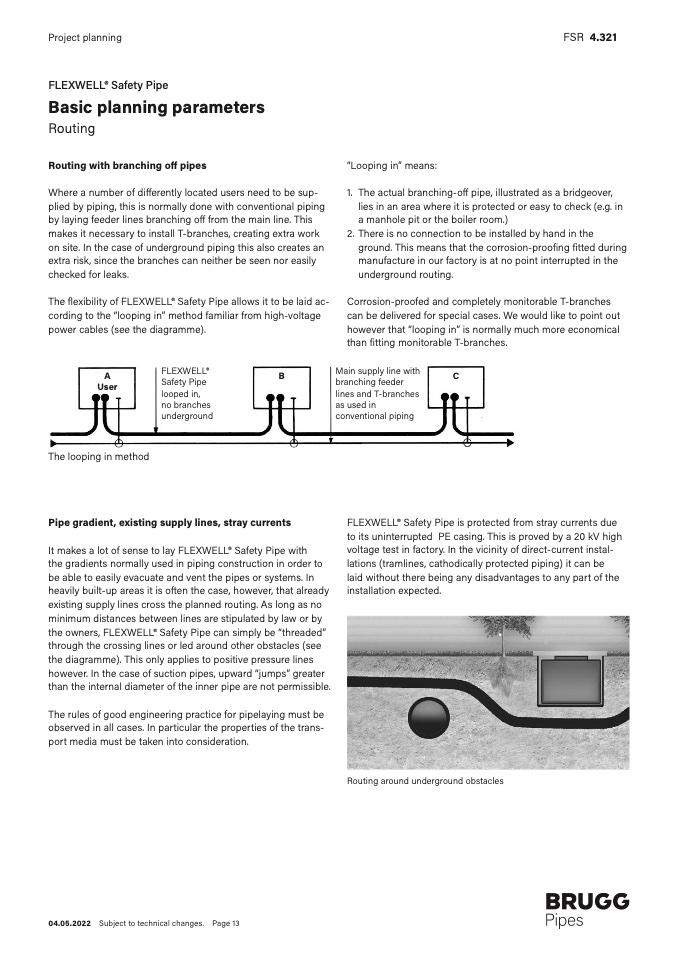
the owners, FLEXWELL® Safety Pipe can simply be “threaded”
through the crossing lines or led around other obstacles (see
the diagramme). This only applies to positive pressure line
s
however. In the case of suction pipes, upward “jumps” greater
than the internal diameter of the inner pipe are not permissible.
The rules of good engineering practice for pipelaying must be
observed in all cases. In particular the properties of the trans
-
port media must be taken into consideration.
FLEXWELL® Safety Pipe is protected from stray currents due
to its uninterrupted PE casing. This is proved by a 20 kV high
voltage test in factory. In the vicinity of direct-current instal-
lations (tramlines, cathodically protected piping) it can b
e
laid without there being any disadvantages to any part of the
installation expected.
Routing around underground obstacles
04.05.2022 Subject to technical changes. Page 13

